




From Sheet To Box: The Complete Process Of Carton Manufacturing Explained
Every corrugated box starts as a simple flat sheet of paperboard — yet through a precise and well-engineered process, it becomes a durable, custom-sized packaging solution ready to protect goods around the world.
The carton manufacturing process blends art and engineering, requiring advanced machinery, skilled operation, and strict quality control. At Jingou Packaging Machinery, we design and manufacture intelligent equipment that makes this transformation faster, more efficient, and more sustainable.
In this article, we’ll take you step by step through the journey from sheet to box, explaining how modern carton production lines work and how automation enhances every stage.
1. Corrugated Board Preparation
1.1 Paper Reel Selection
The process begins with choosing the right linerboard and corrugating medium. These paper reels form the outer and inner layers of the corrugated sheet. The quality, weight (gsm), and moisture content of the paper directly affect the final box’s strength.
1.2 Corrugating and Laminating
In a corrugator machine, the fluting paper passes through heated rollers to form corrugated waves, which are then glued between liner sheets. The result is a strong yet lightweight multi-layer board.
The laminated board is then dried, trimmed, and cut into flat sheets — the foundation for the next stages of carton production.
2. Slitting and Scoring
Once the corrugated sheets are prepared, they are processed through a slitter scorer machine.
| Step | Function | Purpose |
|---|---|---|
| Slitting | Longitudinal cutting using thin blades | Cuts the board into panels of the desired width |
| Scoring | Pressing crease lines into the board | Prepares the sheet for clean folding |
Jingou’s auto thin-blade slitter scorer machines use servo-driven positioning and memory settings to ensure ±0.5 mm cutting precision, minimal paper fiber loss, and perfect crease alignment — crucial for consistent box folding quality.
3. Slotting and Creasing
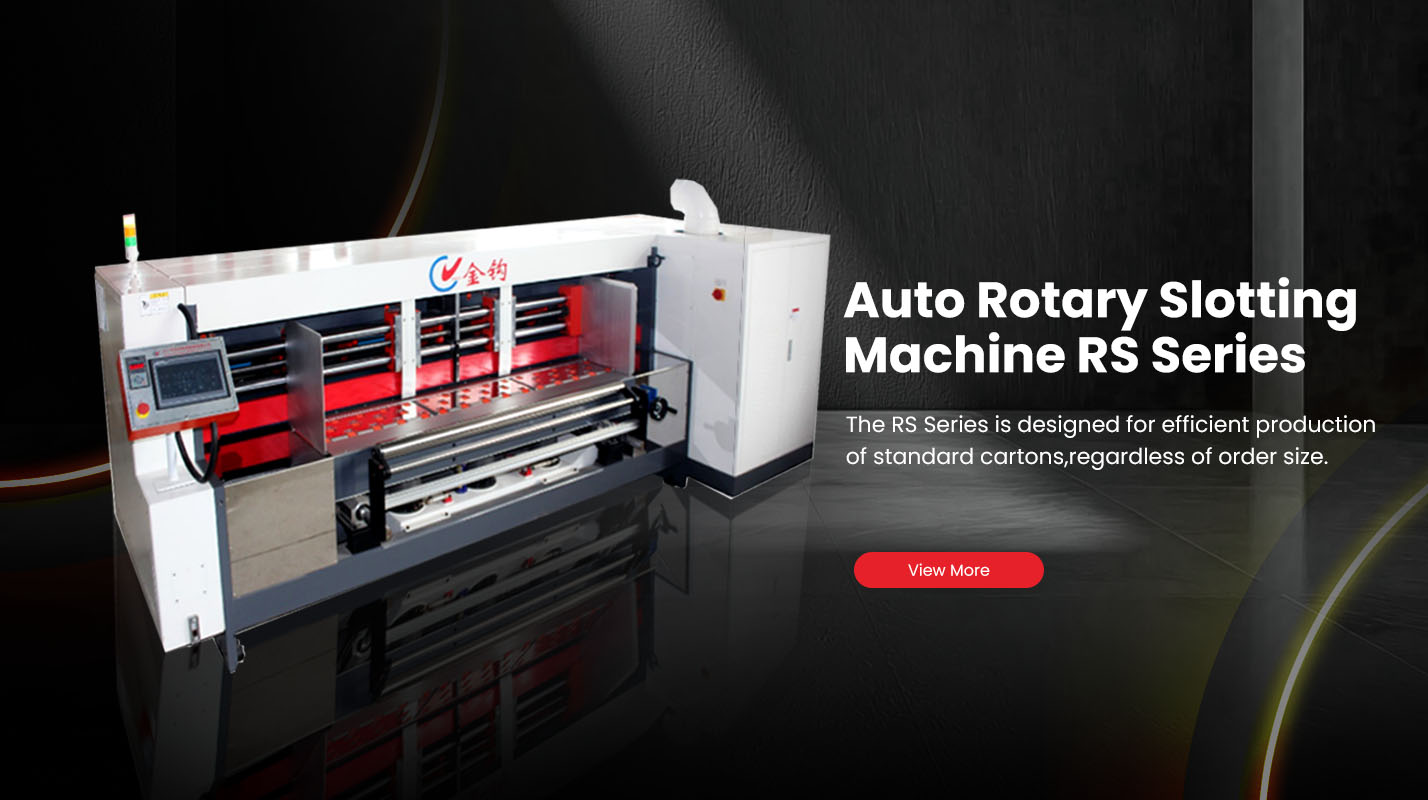
Next, the pre-cut and scored sheets move to a rotary slotter machine.
This stage defines the box shape and flap structure:
Slotting: Cuts vertical slots for the flaps that will later form the box edges.
Corner Cutting: Removes excess material for proper folding.
Creasing: Adds precise fold lines for flap bending.
Jingou’s slotters integrate servo motors for accurate head adjustment and synchronization with the slitter scorer. The result: clean edges, uniform panels, and flawless folding geometry.
4. Printing and Branding (Optional Stage)
If required, boxes can be printed before or after slotting using flexographic or digital printing systems.
Modern printing units, often integrated into Jingou’s automatic lines, apply:
Brand logos and product details
Handling instructions and barcodes
Decorative patterns for retail packaging
Servo registration control ensures that the printed design aligns perfectly with the slot and fold layout, even at high speed.
5. Folding and Gluing
The slotted and printed sheets enter a folding and gluing machine, which forms them into flat, collapsible cartons.
The machine:
Applies adhesive along pre-defined glue flaps
Folds panels precisely along creases
Uses pressing rollers to bond the glued areas securely
Automated folding units, guided by digital control panels, ensure that every box maintains its shape and structural integrity — ready for stacking or bundling.
6. Counting, Stacking, and Bundling
After forming, the boxes are automatically counted and stacked for packaging. Servo-controlled conveyors align the cartons neatly, while automatic bundlers strap them together for shipping.
This final stage ensures:
Accurate quantity per bundle
Safe handling and transport
Streamlined workflow for storage or delivery
Jingou’s fully automatic carton lines combine all these stages — from sheet feeding to stacking — under one intelligent PLC system for maximum productivity.
7. Quality Control and Inspection
Before shipment, finished cartons undergo dimensional checks, compression tests, and visual inspection. The goal is to ensure that each box meets performance standards such as:
Correct size and flap alignment
Strong bonding and folding accuracy
Consistent surface finish and print registration
With Jingou’s built-in monitoring systems, quality data is automatically collected and displayed on the digital control panel — helping operators maintain production standards with ease.
8. Key Advantages of Automation in Carton Production
| Automation Feature | Jingou Solution | Productivity Benefit |
|---|---|---|
| Servo Drive Control | Multi-axis synchronization | ±0.5 mm accuracy at high speed |
| Auto Order Memory | Stores up to 100+ configurations | Instant changeovers |
| Digital Control Panel | Centralized interface | Simplifies operation and reduces training |
| Thin-Blade Slitting | Precise, low-fiber-loss cutting | Better edge quality and less waste |
| Vacuum Sheet Feeding | Steady material flow | Prevents jams and misfeeds |
| Real-Time Monitoring | Built-in diagnostics | Minimizes downtime |
By integrating these intelligent systems, Jingou Packaging Machinery helps manufacturers achieve higher output, lower costs, and consistent box quality — the hallmarks of modern packaging production.
9. Sustainable Manufacturing Practices
Sustainability is becoming central to carton manufacturing. Jingou’s machines support eco-friendly production by:
Reducing waste through precise cutting and scoring
Lowering energy consumption via optimized servo drives
Extending machine life with durable components
Supporting recyclable corrugated materials
By combining efficiency with sustainability, Jingou helps factories meet both business goals and environmental commitments.