




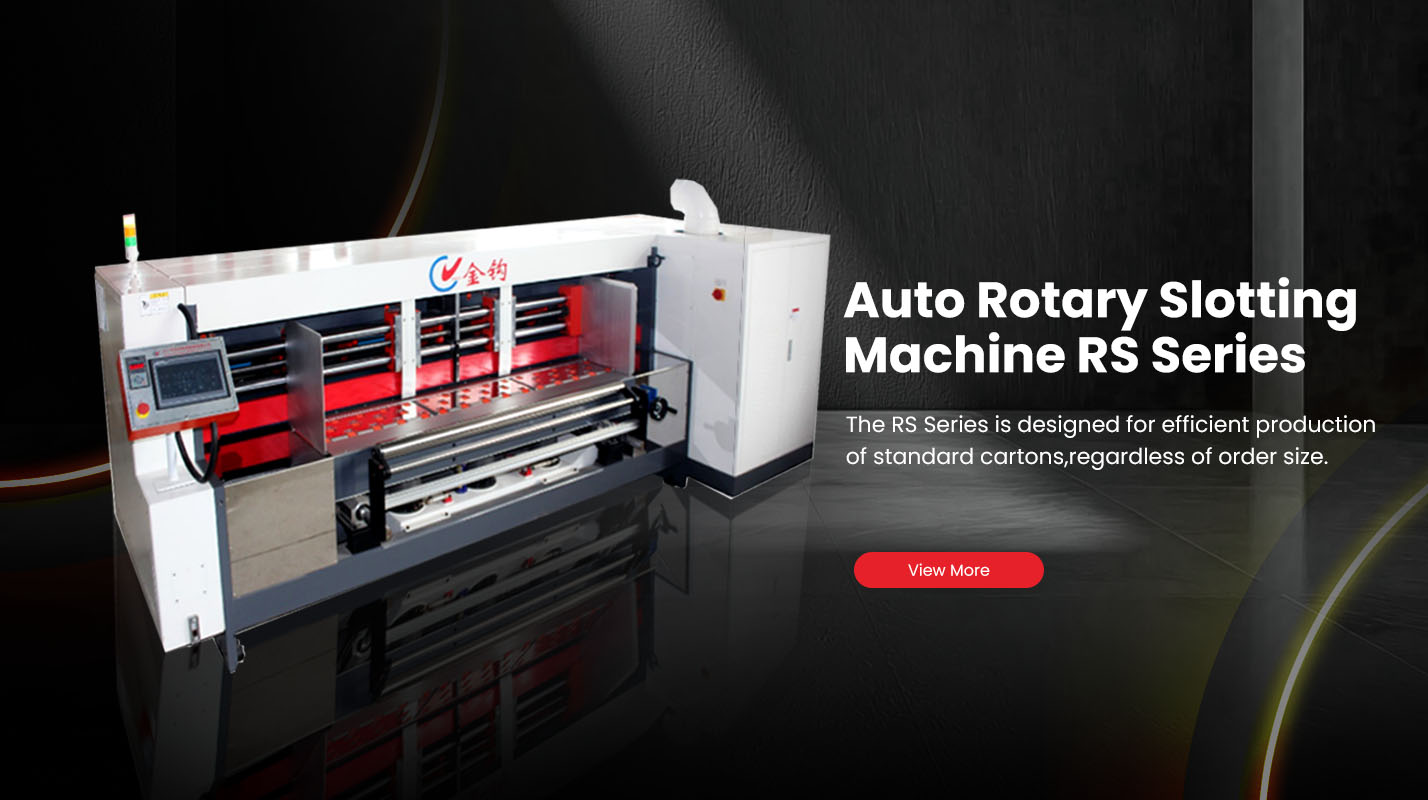
In corrugated carton manufacturing, several specialized machines are used to process corrugated boards into finished packaging products. Among the most commonly used equipment are printer slotter machines and rotary die cutter machines. Although both machines are used in carton converting processes, they perform different functions and are designed for different packaging structures.
Understanding the difference between these two machines helps packaging factories select the most suitable equipment for their production requirements. As a manufacturer of carton processing equipment, Jingou Packaging Machinery focuses on developing machines that support efficient and precise corrugated box production.
Printer Slotter Machine
A printer slotter machine combines printing and slotting functions within one integrated system. This machine is commonly used for producing standard corrugated cartons such as regular slotted containers.
During operation, corrugated boards first pass through the printing unit where flexographic printing plates apply graphics, logos, or product information onto the board surface. After printing, the board moves to the slotting section where rotating blades create slots that define the carton flaps and panel structure.
Printer slotter machines are widely used for mass production of standard cartons because they can perform multiple processes within a continuous production line. The integrated structure allows packaging factories to maintain high production efficiency while producing cartons with printed information.
Rotary Die Cutter Machine
Rotary die cutter machines are designed to produce cartons with complex shapes or customized structures. Instead of using slotting blades, these machines use a cylindrical die cutting mold to cut the corrugated board.
The die cutting mold contains blades arranged according to the required packaging design. As the corrugated board passes through the rotating cylinder, the mold cuts the board into the desired shape.
Rotary die cutters are commonly used for producing packaging products such as display boxes, customized packaging structures, and cartons with special openings or folding patterns.
Because the cutting pattern is determined by the die mold, rotary die cutting machines provide greater flexibility for producing unique packaging designs.
Key Functional Differences
Printer slotter machines focus on producing standard carton structures efficiently, while rotary die cutters are designed for specialized packaging shapes.
Printer slotter machines combine printing and slotting operations, making them suitable for large-scale production of regular cartons used in logistics and transportation.
Rotary die cutter machines focus on shape cutting and structural customization, allowing manufacturers to produce complex packaging designs that cannot be created through standard slotting processes.
Manufacturer vs Trader When Choosing Equipment
When sourcing carton converting equipment, buyers often evaluate whether to purchase machines directly from manufacturers or through trading intermediaries.
Manufacturers control the entire equipment production process including engineering design, machining, assembly, and performance testing. This allows them to maintain strict quality standards and provide technical guidance for equipment configuration.
Trading companies often supply machines from different factories and may have limited involvement in the equipment design process.
Jingou Packaging Machinery operates its own production facility and engineering team, enabling the development of carton machinery designed for reliable performance in modern packaging production lines.
OEM and ODM Equipment Development
Packaging factories frequently require equipment customized for their production environment. OEM and ODM collaboration allows machinery manufacturers to design equipment according to carton dimensions, printing requirements, and production capacity.
The development process typically begins with technical requirement analysis followed by engineering design and prototype testing. Performance verification ensures that the equipment meets processing accuracy and production speed requirements before entering full manufacturing.
Manufacturing Process Overview
The production of carton converting machinery involves several stages including precision machining, module assembly, and system integration.
Machine frames, shafts, and transmission components are produced using precision machining equipment to ensure dimensional accuracy. Functional modules such as printing units, slotting assemblies, and feeding systems are assembled separately before final machine integration.
Electrical control systems coordinate machine operation and maintain stable production performance.
Quality Control Checkpoints
Quality inspection procedures ensure that machinery performs reliably during industrial production.
Manufacturers inspect raw materials before machining begins. Machining accuracy checks verify that components meet tolerance requirements. Assembly alignment inspections ensure that cutting tools and mechanical systems operate correctly.
Operational testing simulates production conditions to confirm machine stability before shipment.
Material Standards Used
Industrial carton machinery requires durable materials capable of supporting continuous production.
High-strength structural steel is used for machine frames, while precision alloy steel components are used in transmission systems and rotating shafts. Cutting components use wear-resistant materials to maintain processing accuracy over extended production cycles.
Bulk Supply Considerations
Large packaging factories often procure multiple machines when expanding production capacity. Bulk procurement requires coordinated production scheduling, logistics planning, and installation preparation.
Manufacturers must ensure consistent equipment quality across all machines delivered in a project. Operator training and technical support also help ensure stable machine performance.
Export Market Compliance
Packaging machinery exported to international markets must comply with industrial safety regulations and technical documentation requirements. These include electrical safety standards, operational protection systems, and installation manuals necessary for overseas operation.
Proper export packaging and transportation arrangements are also required to ensure safe delivery of heavy machinery.
Conclusion
Printer slotter machines and rotary die cutter machines serve different roles in corrugated carton manufacturing. Printer slotters are designed for efficient production of standard cartons with printing capability, while rotary die cutters are used for producing customized packaging structures with complex shapes.
Selecting the appropriate equipment depends on packaging design requirements, production volume, and factory workflow. Manufacturers with strong engineering capability and structured production systems can provide reliable equipment solutions for modern corrugated packaging factories. Jingou Packaging Machinery continues to develop carton processing equipment designed to support efficient and stable carton manufacturing operations.