




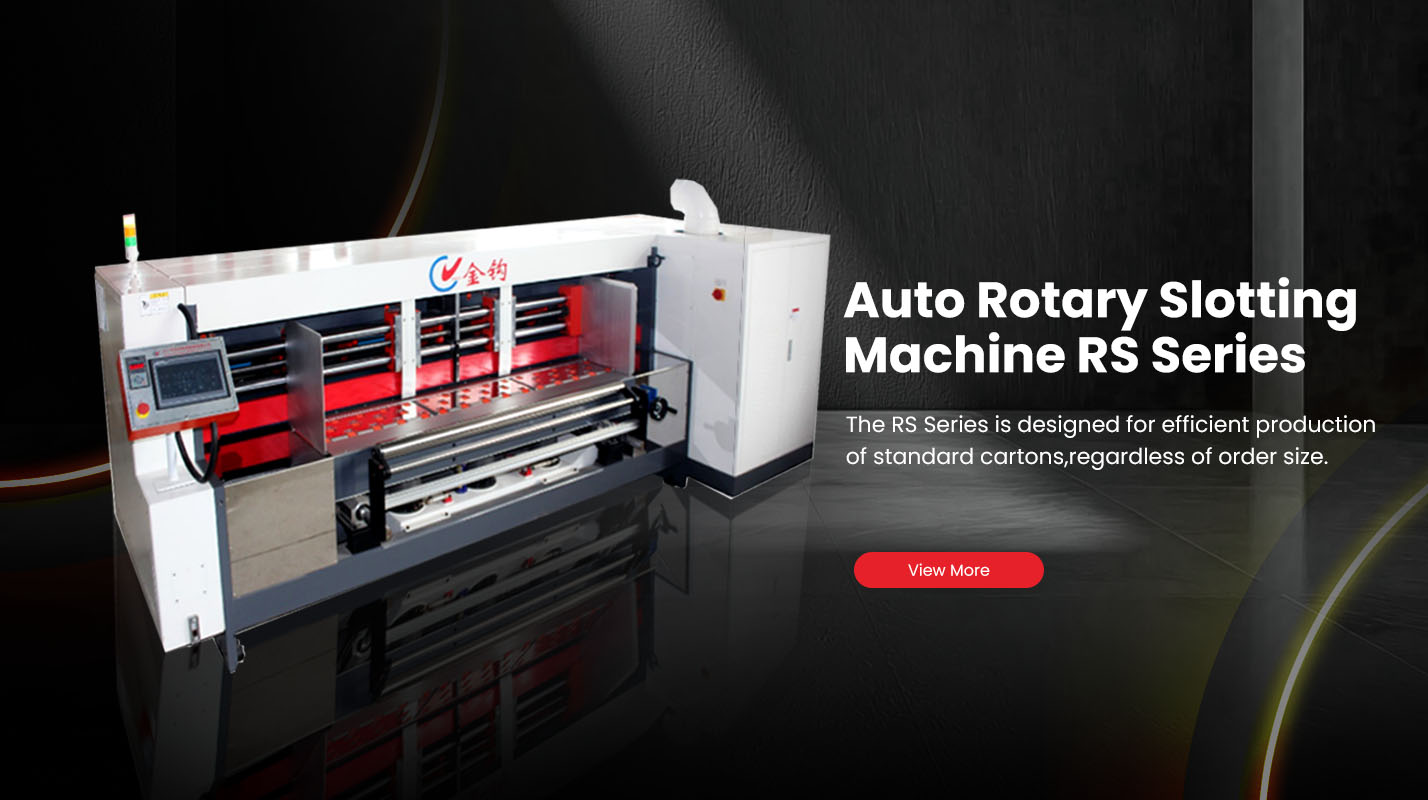
Corrugated board is one of the most widely used packaging materials in logistics, retail distribution, and industrial transportation. The machine responsible for producing corrugated board from raw paper is the corrugator. This equipment transforms kraft paper rolls into strong multi-layer boards through a continuous process of heating, forming, bonding, and cutting.
A corrugator is the core machine in a corrugated cardboard production line. By combining mechanical forming technology and adhesive bonding processes, it creates the fluted structure that gives corrugated board its strength and cushioning properties. Manufacturers such as Jingou Packaging Machinery focus on developing equipment designed to support stable and efficient corrugated board production.
Paper Feeding and Unwinding
The production process begins with kraft paper rolls mounted on paper roll stands. These large paper rolls serve as the raw material for the corrugated board.
The roll stand allows controlled unwinding of the paper while maintaining proper tension. Stable feeding ensures that the paper moves smoothly into the corrugating section without wrinkles or alignment problems.
Consistent paper tension is essential because uneven feeding can affect the shape and stability of the corrugated flute structure.
Paper Preheating
Before the corrugation process begins, the paper sheets pass through preheating units. These machines apply controlled heat to prepare the paper for forming and bonding.
Preheating softens the paper fibers and removes excess moisture. This makes the paper more flexible and improves the bonding strength between layers during the adhesive process.
Proper temperature control at this stage helps ensure uniform board quality throughout the production run.
Corrugating Process
The key stage of the process occurs in the corrugating section. In this unit, the medium paper is pressed between heated corrugating rollers that shape the paper into a wave-like flute pattern.
These flutes form the inner structure of the corrugated board and provide compression strength and cushioning ability. Different flute profiles can be produced depending on the required packaging performance.
The corrugating rollers maintain high temperature and pressure to ensure that the flute structure remains stable during production.
Adhesive Application
After the medium paper is formed into flutes, adhesive is applied to the flute tips. This adhesive bonds the fluted medium to the linerboard sheets that form the outer layers of the corrugated board.
Adhesive application must be evenly distributed to ensure strong bonding without excessive moisture. Proper adhesive control helps maintain board strength and dimensional stability.
Double Backing Process
Once the fluted medium and linerboard are bonded, the board passes through the double backer section. This stage applies heat and pressure to finalize the bonding process.
The double backer stabilizes the multi-layer board structure and ensures that all layers are securely attached. This process also removes excess moisture from the adhesive, improving board strength.
Slitting and Scoring
After the corrugated board structure is completed, it moves to the slitting and scoring section. Slitting blades cut the board into the required width, while scoring wheels create fold lines for carton forming.
Thin blade slitter scorer machines are commonly used in this stage because they provide precise cutting and clean board edges.
Accurate slitting and scoring ensure that the board can later be converted into cartons with correct dimensions.
Sheet Cutting and Stacking
The final stage of the corrugator process is cutting the board into sheets. A cut-off machine divides the continuous board into lengths based on carton production requirements.
Finished board sheets are then automatically stacked and prepared for transport to carton converting machines such as slotters or die cutters.
Manufacturer vs Trader in Equipment Sourcing
When sourcing corrugator equipment, buyers often consider whether to work directly with a manufacturer or through a trading intermediary.
Manufacturers typically control the entire production process including machine design, material selection, machining, and assembly. This allows them to maintain higher quality standards and provide technical support for machine installation and operation.
Trading companies may distribute equipment from different factories and may not control the engineering design or manufacturing process.
Jingou Packaging Machinery operates its own production facility and engineering team, enabling the development of machinery designed for reliable corrugated board production.
OEM and ODM Equipment Development
Corrugated board manufacturers often require machines customized for their production conditions. OEM and ODM cooperation allows machinery manufacturers to design equipment according to production width, board specifications, and capacity requirements.
The development process typically includes requirement analysis, engineering design, prototype testing, and performance validation. After testing confirms machine performance, equipment enters standardized manufacturing and assembly stages.
Manufacturing Process Overview
The production of corrugator equipment requires precise machining and structured assembly procedures.
Machine frames, rollers, and transmission components are manufactured using precision machining equipment to ensure dimensional accuracy. Mechanical modules such as corrugating units and feeding systems are assembled before final system integration.
Electrical control systems including PLC controllers coordinate machine operations and maintain stable production performance.
Quality Control Checkpoints
Quality control procedures ensure that corrugator equipment performs reliably in industrial production environments.
Manufacturers inspect raw materials before machining begins. Machining accuracy checks verify that components meet dimensional tolerance standards. Assembly alignment inspections confirm that mechanical systems operate correctly.
Operational testing simulates real production conditions to ensure machine stability before shipment.
Material Standards Used
Industrial corrugator machines require durable materials capable of supporting continuous operation.
High-strength structural steel is commonly used for machine frames to provide mechanical stability. Precision alloy steel components are used for rollers and transmission systems, while wear-resistant materials are used in key mechanical parts.
These materials help ensure long-term reliability and stable production performance.
Bulk Supply Considerations
Large packaging factories expanding production capacity often purchase multiple machines as part of equipment investment projects. Bulk procurement requires coordinated production scheduling, logistics planning, and installation preparation.
Manufacturers must ensure consistent equipment quality across all machines delivered within a project.
Export Market Compliance
Corrugator equipment exported to international markets must comply with industrial safety regulations and documentation requirements. These include electrical safety standards, machine protection systems, and technical manuals necessary for installation and operation.
Proper export packaging and transportation planning are also required to ensure safe delivery of heavy machinery.
Conclusion
A corrugator converts kraft paper into corrugated board through a continuous process of feeding, heating, forming, bonding, and cutting. Each stage of the process plays an essential role in ensuring the strength and stability of the final board product.
Manufacturers with strong engineering capability, structured production systems, and strict quality control procedures are able to provide reliable equipment solutions for modern packaging factories. Jingou Packaging Machinery continues to develop carton processing equipment designed to support efficient and stable corrugated board production.